
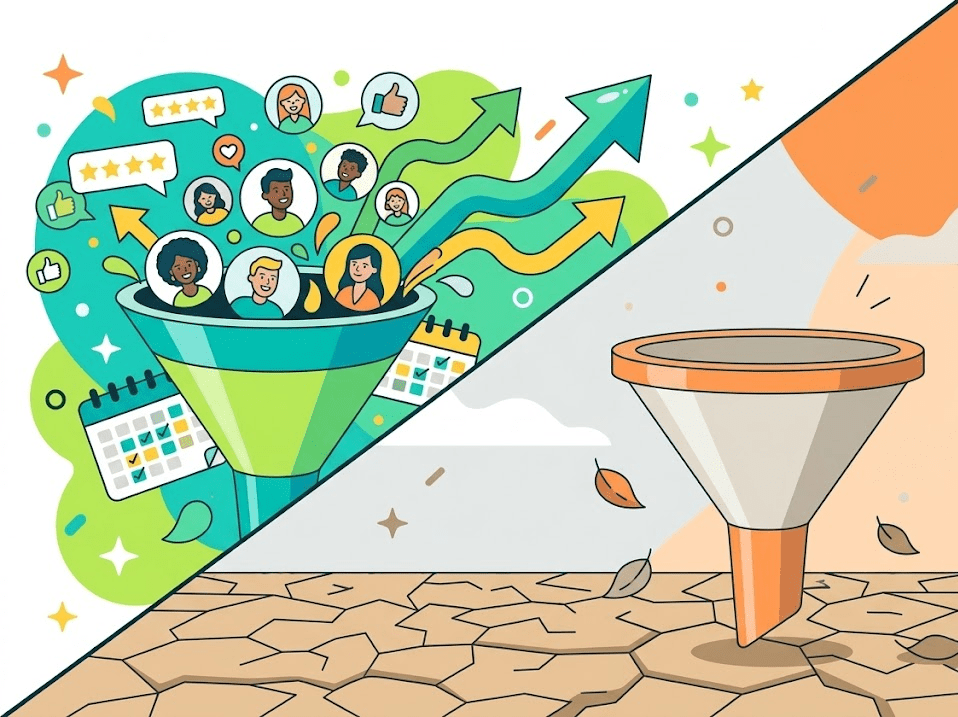
Why Service Businesses Experience Feast and Famine Sales
Many service businesses experience the same pattern.
One period the business is busy.
Projects are running.
The pipeline feels healthy.
There is plenty of work.
Then a few months later things suddenly slow down.
Enquiries drop.
The pipeline is empty.
And the founder starts worrying about where the next client will come from.
We call that pattern feast and famine sales.
It’s also extremely common in service businesses.
The Real Cause
Most founders assume feast and famine happens because marketing is weak or the market has slowed down, but in many cases the cause is simpler.
Growth activity stops when the business gets busy.
Networking stops.
LinkedIn posting disappears.
Marketing becomes something to do “when things calm down”.
But the pipeline that feeds future work is usually built months earlier.
If marketing activity stops today, the impact might not appear for one to six months.
By the time founders notice the pipeline is empty, the slowdown has already started. Ouch.
The Vicious Cycle
This problem is often made worse by pricing.
Many service founders charge too little for their services.
To earn enough income they need to fill their calendar with client work so when the business becomes busy, all attention shifts to delivery.
Recently I saw this happen with a founder whose business had just completed a project where the client was super happy with the result, which speaks highly of the quality and professionalism of the work they delivered.
But as the delivery work increased:
Marketing stopped.
Networking stopped.
Content stopped.
Growth projects disappeared.
Then eventually a project ends, a client slows down or goes out of business. Familiar?
Suddenly the pipeline is quiet.
At that moment the founder panics and starts marketing again.
But by then it is too late to avoid the slowdown.
Busy period.
Marketing stops.
Pipeline slows.
Quiet period.
Marketing restarts.
And the cycle repeats.
The Real Fix
Escaping feast and famine rarely requires complicated marketing strategies.
It usually requires consistency.
Growth activity needs to continue even when the business is busy.
That might include:
Networking.
Posting useful content.
Building referral relationships.
Improving offers and positioning.
These activities may feel less urgent than client work, but they are what feed the pipeline months later.
Next Step
The founders who escape feast and famine usually build simple growth habits. They keep working on sales and marketing every week, even when delivery is demanding.
The Growth Challenge helps founders track the actions that create new opportunities and maintain growth momentum. Join our Growth Challenge Community today for free.